Faster Floor Finishes – Why Cemfloor Beats Anhydrite Screed Every Time
Think of cement-based liquid screed as the evolved version of traditional flooring. Anyone who’s used anhydrite liquid screeds knows they need extensive preparation before tiling – Cemfloor requires no sanding or special primers.
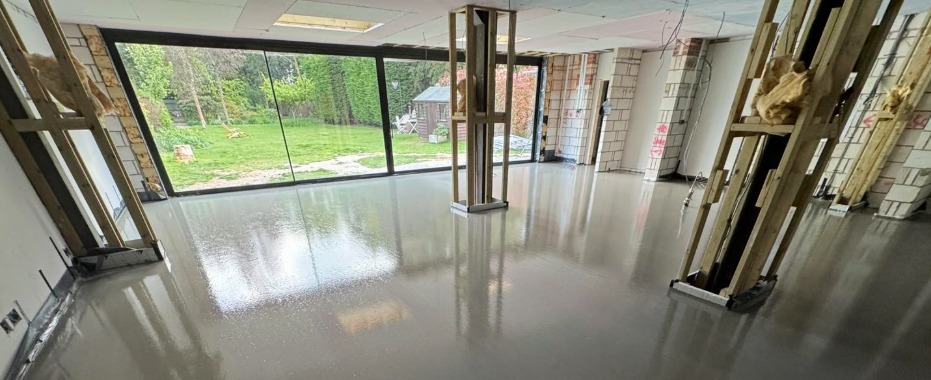
We use this cementitious screed to give our London clients a floor that’s dry enough for tiles in as little as five days. It’s also ideal for UFH installers because, being self-levelling, it ensures a dense, air-free wrap around heating pipes for thermal control.
When you need Cemfloor in London, Essex or the South East, you need a team that knows the science behind the flow. Capital Screeding provides expert supply and installation, guaranteeing that every pour meets strict SR2 flatness standards. We’re screed specialists, providing the hands-on advice and professional delivery that keeps your site on track.
Cement-Based vs. Calcium Sulphate Liquid Screed
If you’ve ever had to wait weeks for a floor to dry, it was probably an anhydrite screed. Calcium-sulphate floors are popular, but there’s a “hidden” cost – the process of sanding and priming.
Cement-based liquid screed behaves like traditional concrete, but it flows like water. It simplifies the build because it doesn’t require sanding to remove laitance, saving you a messy day on-site.
Cementitious screeds are thinner and stronger than anhydrite screeds. You can pour Cemfloor at just 25mm over UFH pipes, which means your heating system responds faster, and your floor-to-ceiling heights stay the same. It’s a more stable material that doesn’t need the same aggressive drying environment as gypsum, making it easier to use in a changeable climate.

Best-fit projects for cement-based screed:
- Energy-efficient retrofits – When optimising UFH output is the goal.
- Commercial floor-outs – Where being able to place 1000m² a day and have it walkable by Tuesday is necessary.
- Tight deadlines – Whenever you cannot afford the 40+ day drying window typical of gypsum products.
- Large Open-Plan Spaces – You can pour up to 150m² without needing a single expansion joint.
- Wet Areas – Ideal for bathrooms or basements where gypsum-based products would struggle.
Our On-Site Installation Process
When it comes to screeding, a builder’s biggest fear is a floor that isn’t level or takes too long to dry. The way we install screed is designed to remove those risks. By using high-viscosity cementitious screed and dappling techniques, we deliver a surface that is ready for foot traffic in as little as 24 hours, so you site doesn’t have to close down for an extended period.
How We Get It Right
Weather-Tight Seal – We check the building is closed to the elements in order to protect the fresh pour.
Borders and Joints – We install expansion strips and plan for control joints at doorways to manage stress points in the floor.
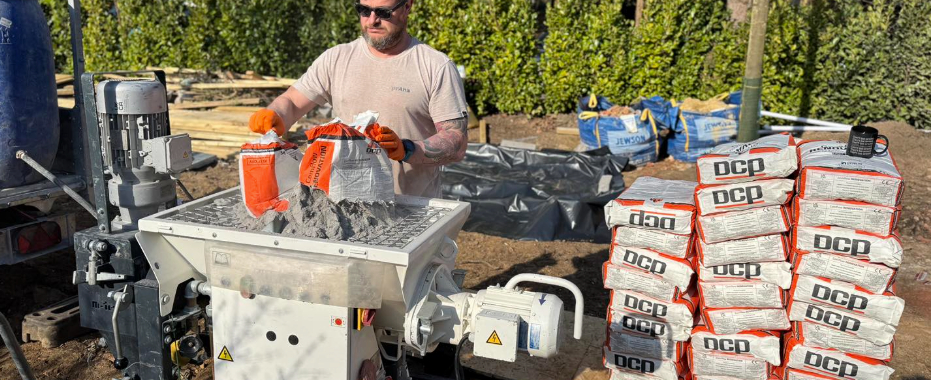
Mix Re-Agitation – Every truck load is mixed at top speed for two minutes on-site to ensure the binder and aggregates are perfectly dispersed.
Precision Pumping – The operator moves the hose in a sweeping motion to fill the area evenly and avoid overfilling the pump.
The Double Dapple – This step levels the floor and ensures that aggregates are evenly distributed.
Early Commissioning – Because we use Cemfloor, we can help you get your underfloor heating commissioned just 7 days after the pour.
Final Preparation – Before you lay your finish, we suggest you lightly abrade the surface to remove building residue and improve adhesive grip.
FAQs – Liquid Screed Tech Specs
When you’re dealing with high-performance materials like Cemfloor, the details matter. Here are some questions we’re regularly asked by our clients.
For non-heated floors, we can go up to 150m² without a single joint. If you have underfloor heating installed, that maximum bay size is 100m². This is a massive advantage over traditional sand and cement, which requires joints far more frequently.
Not with a cement-based mix. Anhydrite screeds can have a nasty chemical reaction with cement-based adhesives (forming ettringite), but because Cemfloor is cement-based, it’s compatible with all standard adhesives and fast-track tiling systems.
We don’t install if the temperature is below 5°C. This is because we need the slab to stay above 5°C for the first 48 hours to ensure it gains enough strength and avoids frost damage.
We use laser-levelled tripods spaced at 1 to 2-metre centres across the entire pour. By following these markers during the pump and using a double-dapple finish, we consistently achieve a surface flatness of SR2 or better.
Stop Waiting for Your Screed to Dry – Let’s Get to Work
If you’re installing a UFH system or managing a large-scale renovation, Capital Screeding can provide the precision and speed you need. Our screeding teams are personable, reliable, and they know the tech.
Contact us for a straightforward price and an installation timeline that works for your business. We’re ready to pump whenever you are – 020 3369 3396